Bloom & Beyond
Order on WhatsApp

+92 339 1000 203

A painting by Hafsa Imran

AyatSigns in the Universe

An old man reads, and the universe rises from the page.

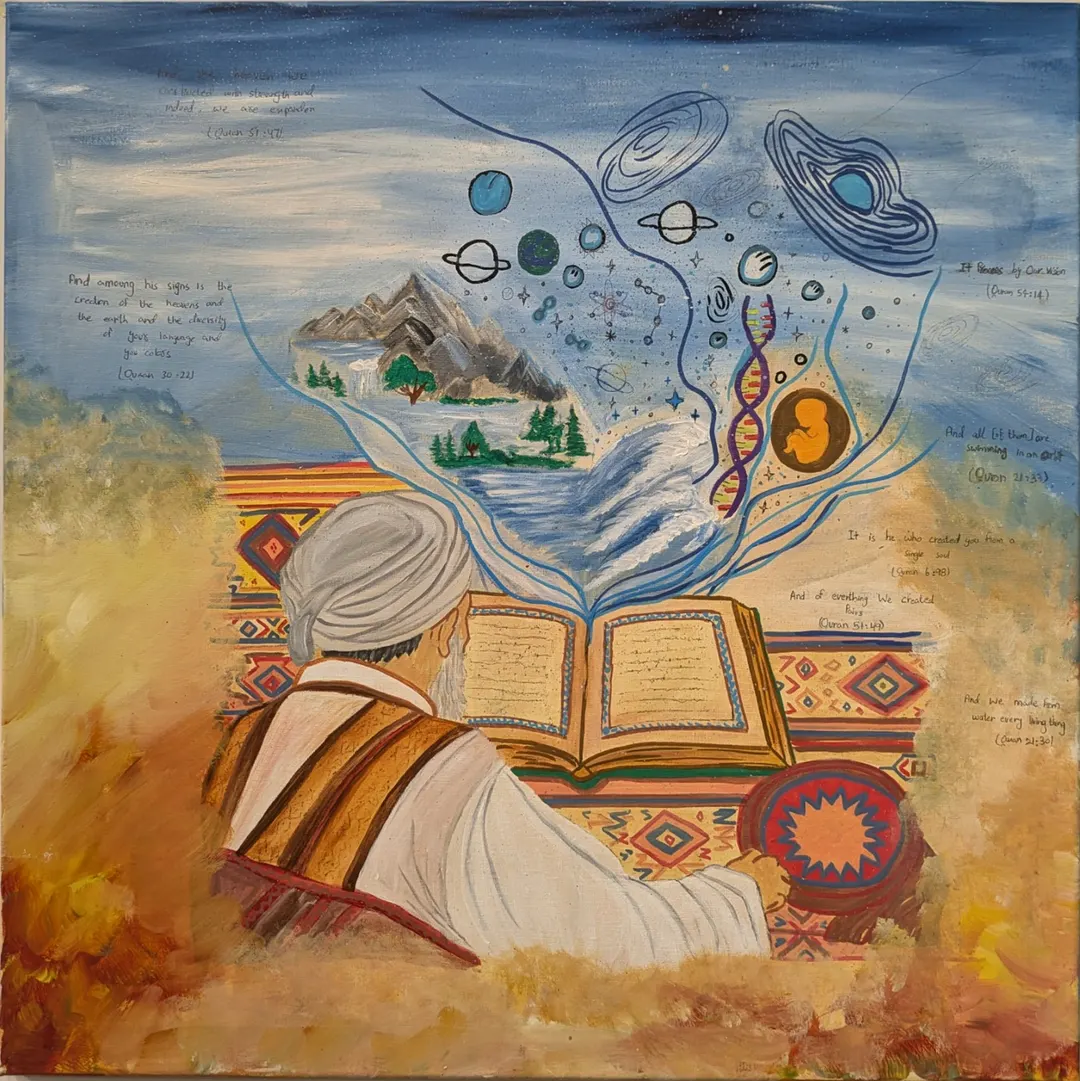
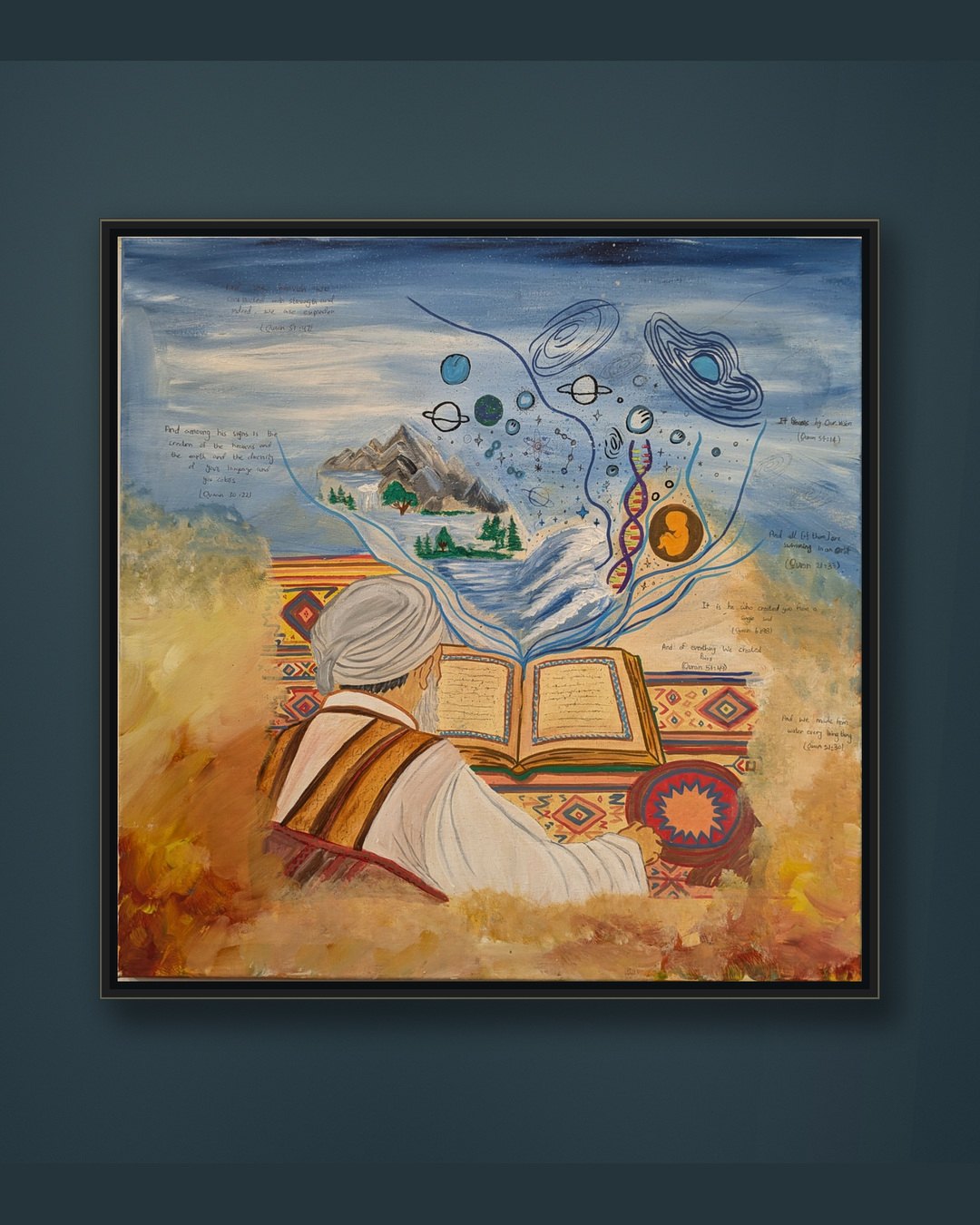
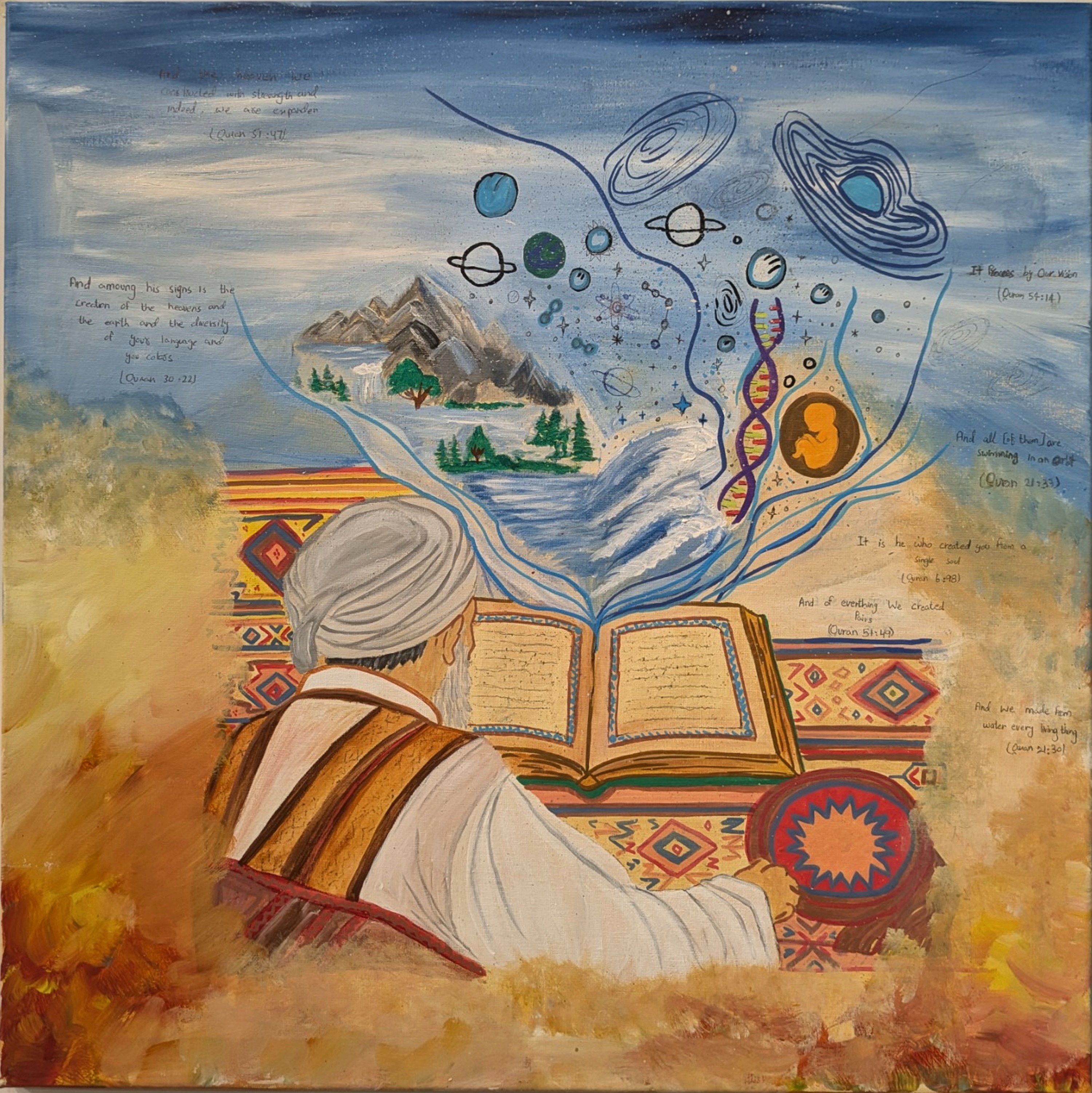
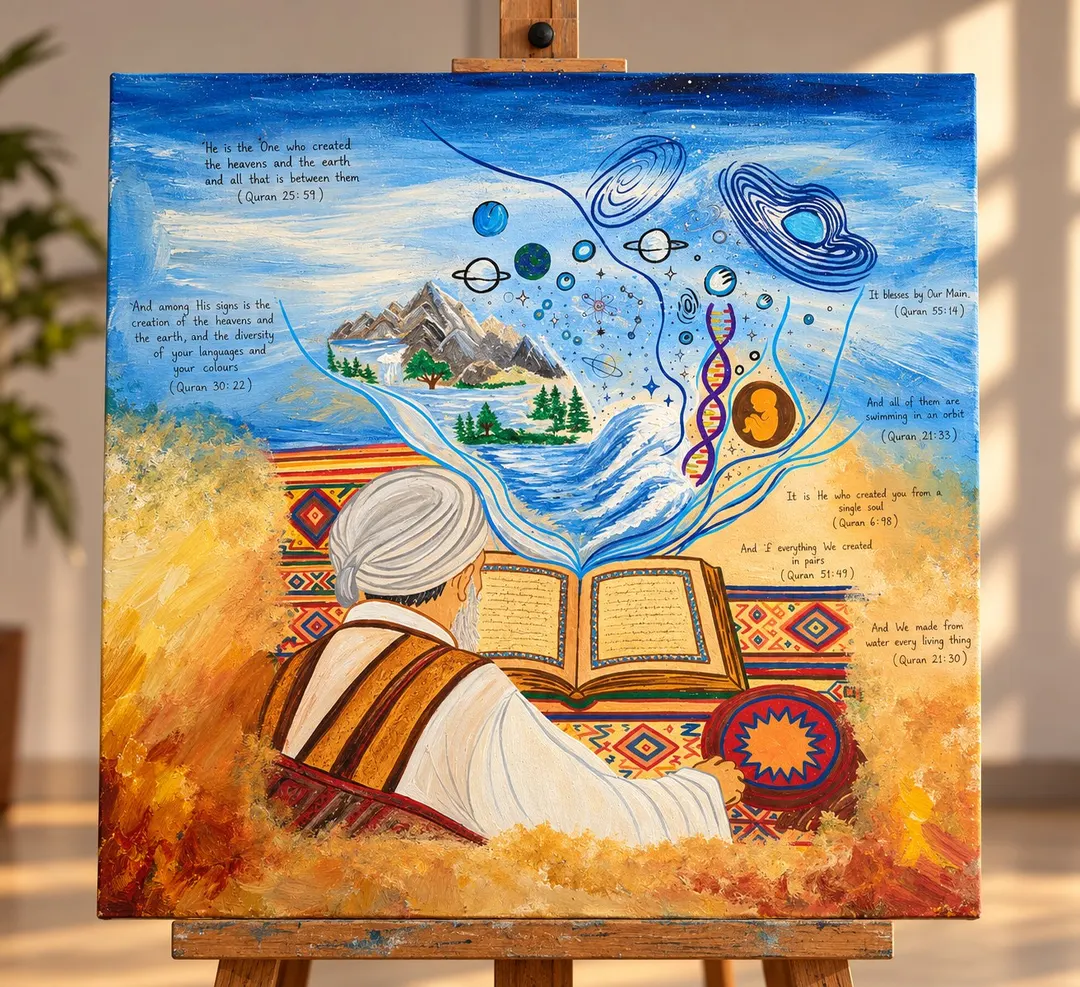
Ayat (Signs in the Universe) is a painting by Lahore artist Hafsa Imran. An elder in a white turban reads the Quran on a wooden stand, and from its open pages a stream rises into mountains, sea, planets, spiral galaxies, a DNA helix and an embryo, beside seven verses about creation written by hand on the canvas. She showed it at Emerging Visuals, Mozart Haus, Lahore, in October 2026.

Ask about Ayat

Last updated:

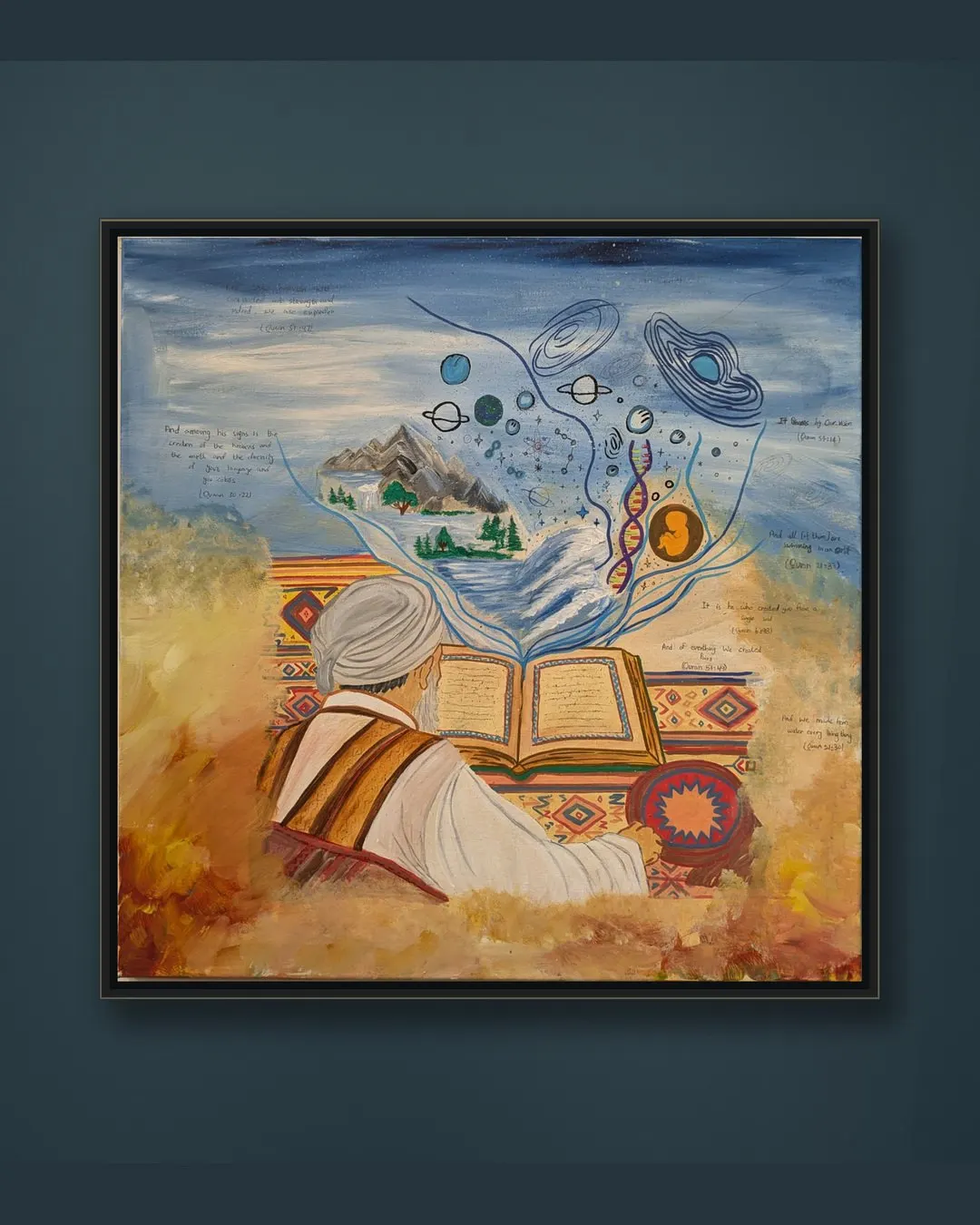
Ayat (Signs in the Universe), a painting by Hafsa Imran: an elder in a white turban, seen from behind, reads an open Quran on a wooden stand over a patterned rug in a golden field, and from its pages a stream rises into mountains, sea, planets, spiral galaxies, a DNA helix and an embryo, beside Quran verses written by hand in the blue sky
Hafsa Imran, Ayat (Signs in the Universe). Hand-painted by Hafsa Imran.

Look closely

What is in the painting

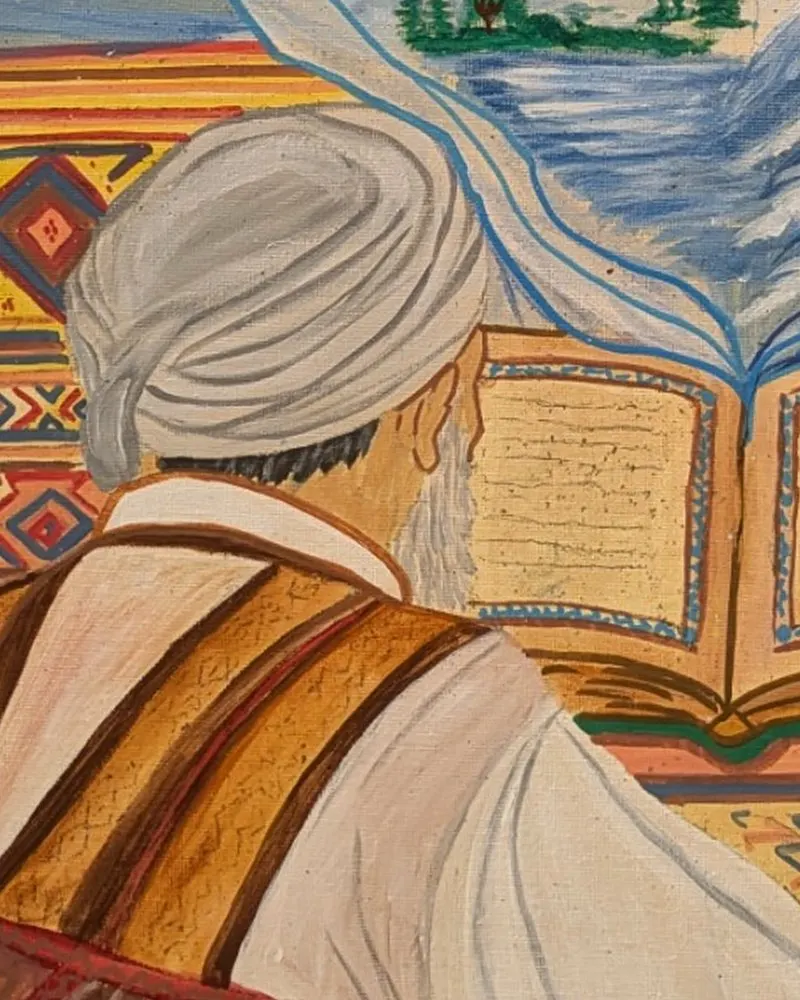
An elder in a white turban sits with his back to us. His robe is white, a striped brown shawl lies over his shoulder, and a grey beard shows at the edge of his face. Before him an open Quran rests on a carved wooden stand, over a rug of red, gold and blue diamonds, in a field of gold.

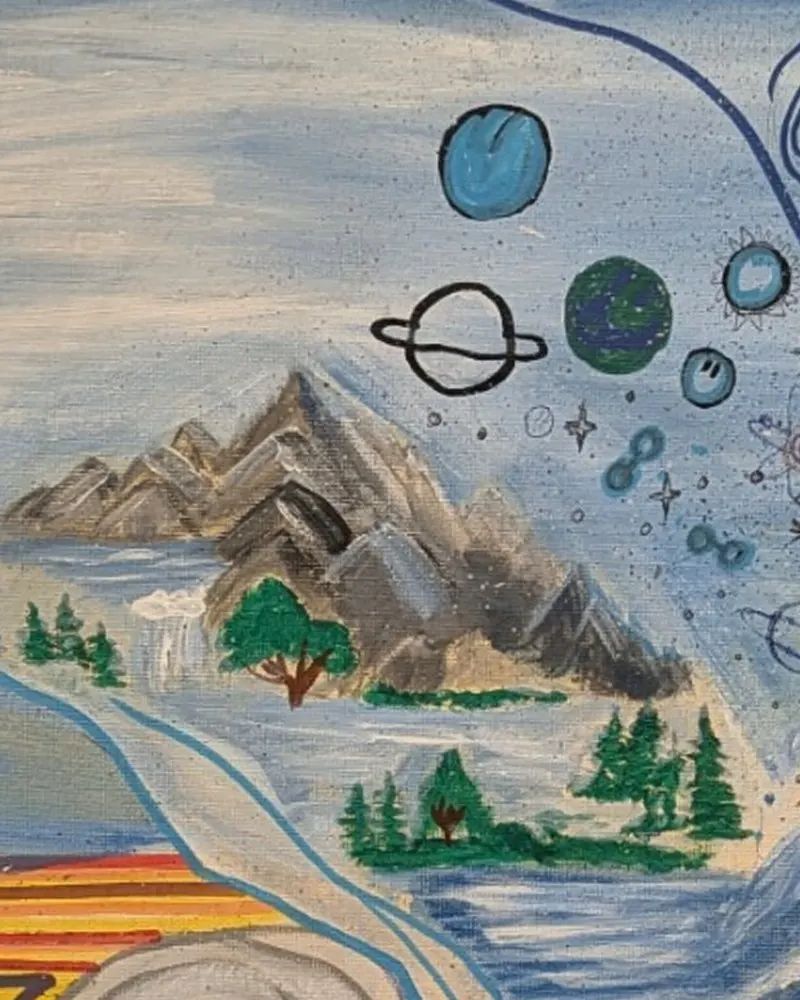
From the open pages a stream of blue lines rises and widens. Inside it the world appears: grey mountains, a small waterfall, green trees and the sea breaking white. Higher up it becomes the sky itself: planets, one of them ringed, spiral galaxies, an atom, a constellation and a swirling disc with a pale-blue centre. Beside them a DNA double helix climbs, and an embryo lies curled in a dark womb.

Seven verses of the Quran are written by hand in English across the sky and the gold, each with its reference: 51:47, 30:22, 54:14, 21:33, 6:98, 51:49 and 21:30.

Artist
Hafsa Imran (Lahore, Pakistan)
Title
Ayat (Signs in the Universe)
Form
Painting, square format
Verses on the canvas
Quran 51:47, 30:22, 54:14, 21:33, 6:98, 51:49 and 21:30, written by hand in English
Exhibited
Emerging Visuals, Mozart Haus, Lahore, October 2026
Images
Photograph of the original painting. The framed versions are digital presentations of the same photograph.
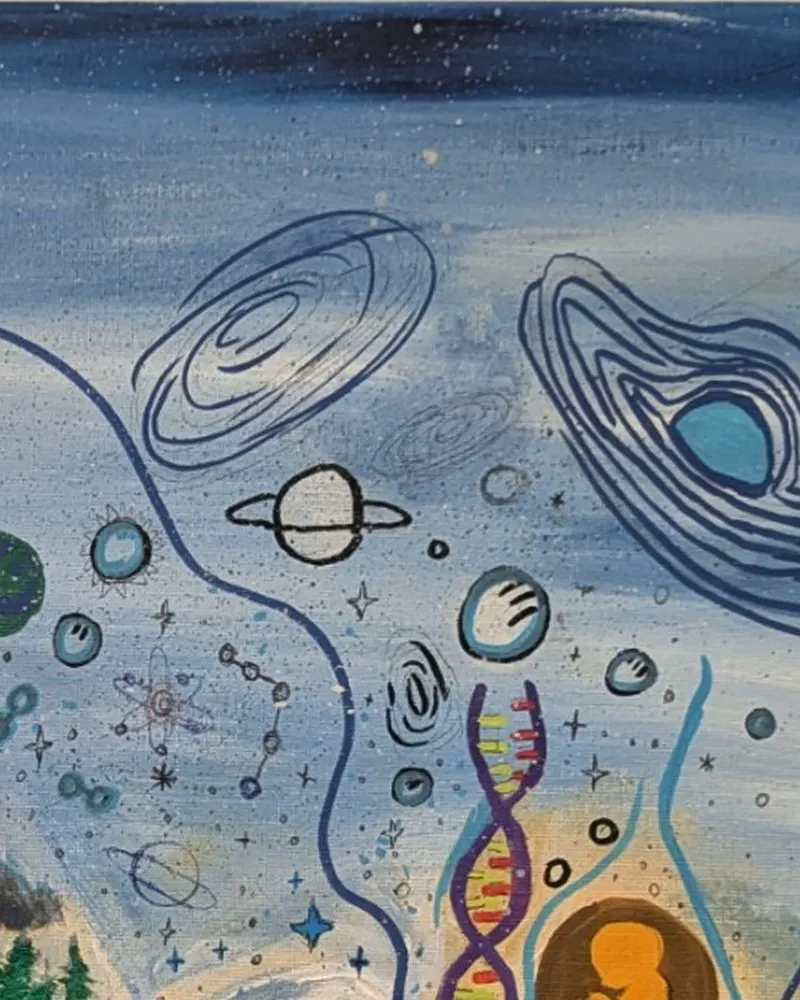
Detail of Ayat by Hafsa Imran: spiral galaxies drawn in blue line, a ringed planet, small moons and a swirling disc with a pale-blue centre in a starry sky
Detail. The horizons: spiral galaxies, a ringed planet and small worlds, each drawn in a single line.
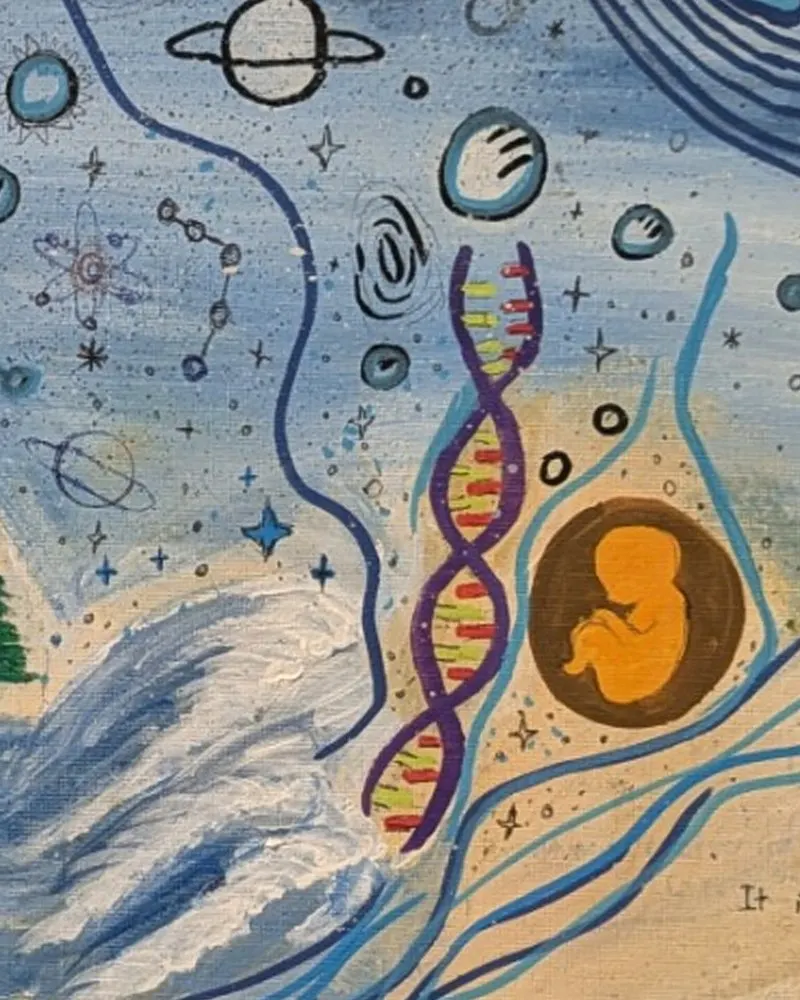
Detail of Ayat by Hafsa Imran: a purple DNA double helix with coloured rungs beside a golden embryo curled inside a dark womb, among stars and an atom
Detail. Within ourselves: the double helix and an unborn child, painted among the stars.
Detail of Ayat by Hafsa Imran: an elder with a white turban and grey beard, in a white robe with a striped brown shawl, reads an open Quran on a carved wooden stand
Detail. The reader: an elder, his back to us, bent over the open Quran.
Detail of Ayat by Hafsa Imran: grey mountains, a small waterfall, green trees and blue water rising out of the stream from the Quran, beneath planets
Detail. The earth rising from the page: mountains, a waterfall, trees and the sea.
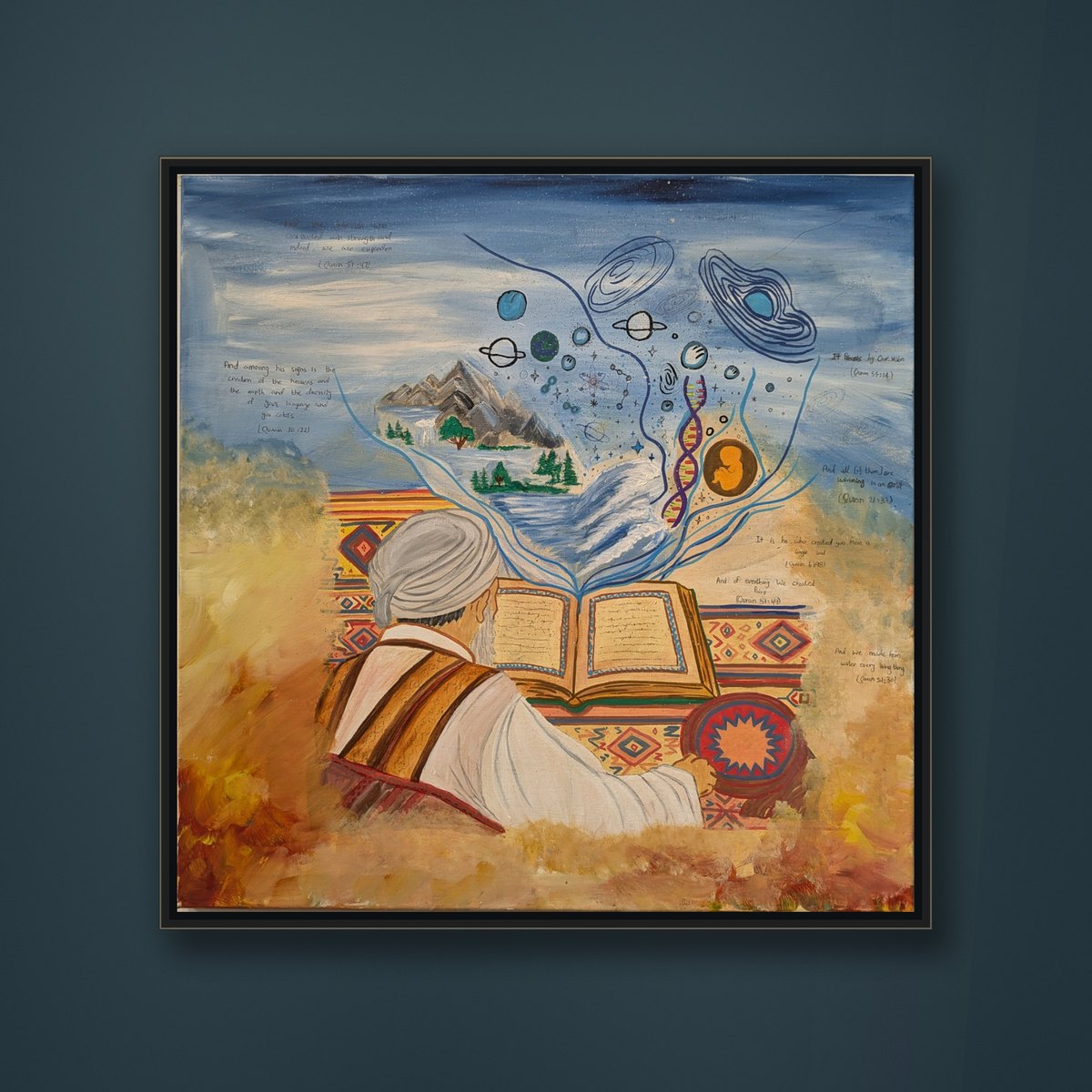
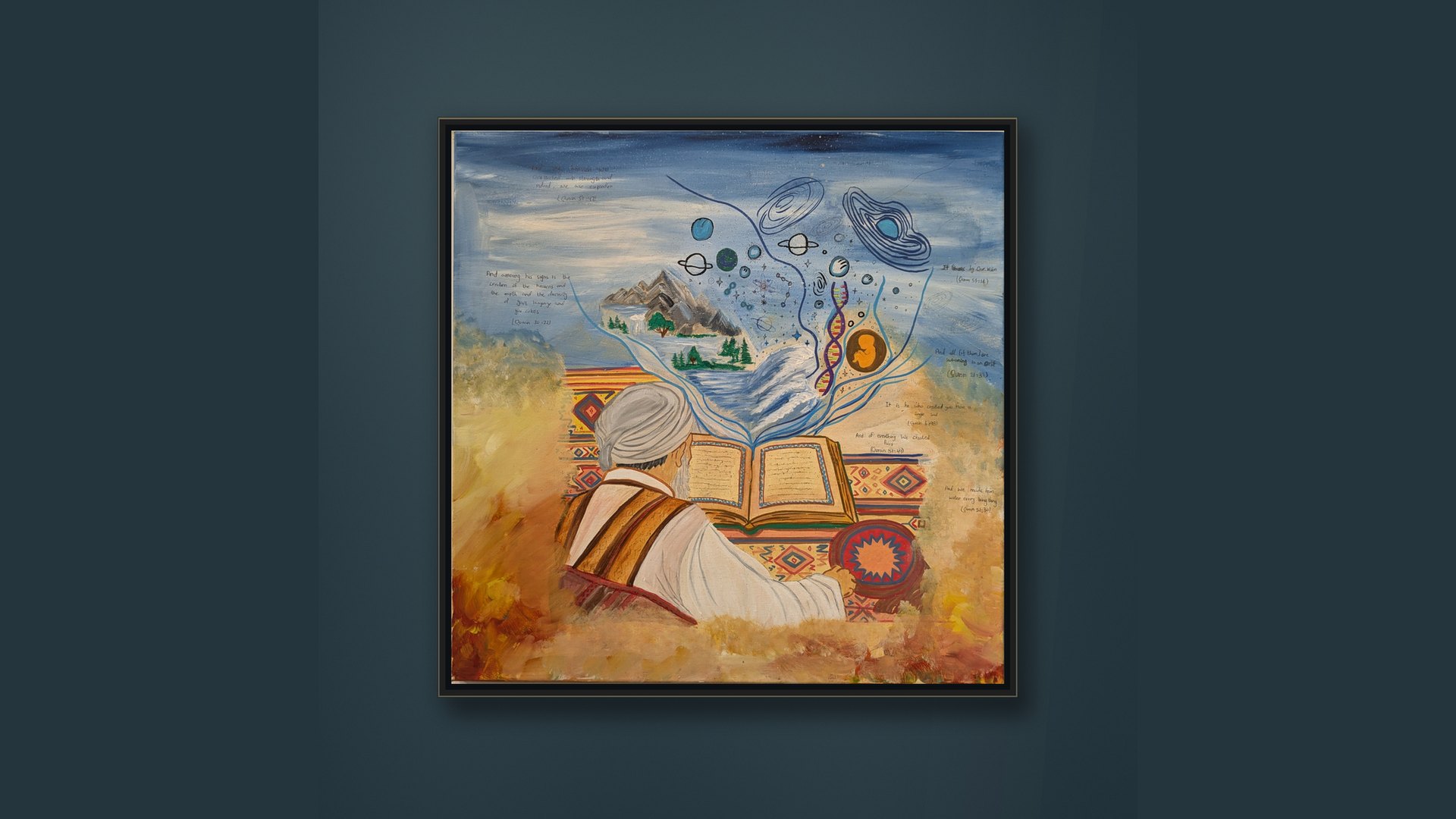
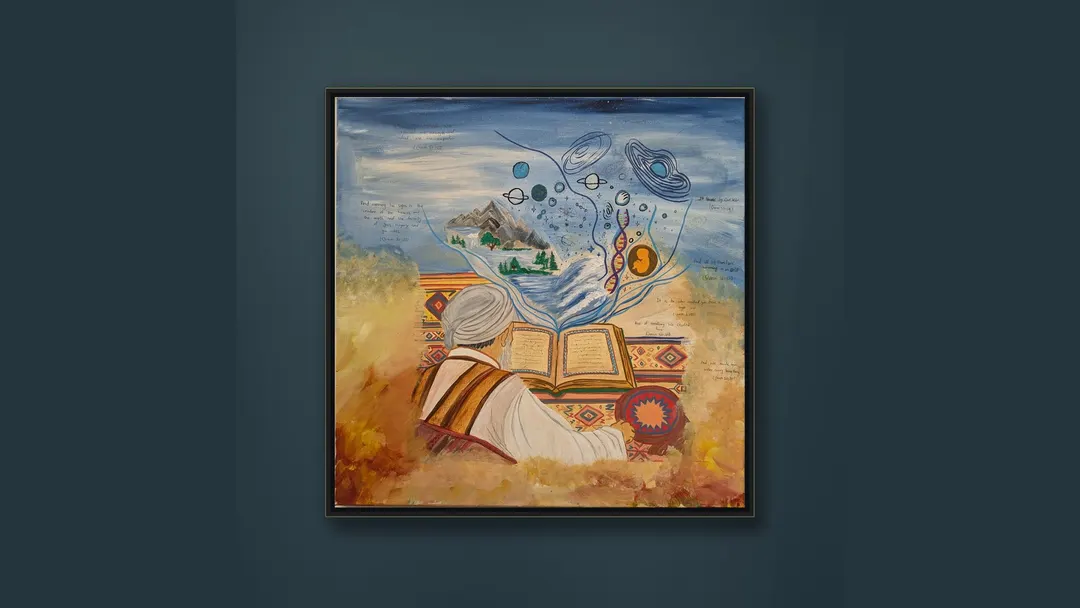
Ayat (Signs in the Universe) by Hafsa Imran, framed, on a wide deep teal wall
Ayat on the wall. The frame and wall are a digital presentation; the painting is the photograph.

The story

Reading Ayat

One word, two meanings

In Arabic, an ayah is a verse of the Quran. It is also a sign: something in the world that points beyond itself. The Quran uses the same word for both, and the painting is built on that double meaning. The old man reads ayat, and ayat rise out of the page.

One verse holds the whole idea, though it is not written on the canvas: "We will show them Our signs in the horizons and within themselves until it becomes clear to them that it is the truth" (41:53, Saheeh International). The painting shows both halves. In the horizons: the planets, the orbits, the galaxies. Within ourselves: the double helix and the child in the womb.
The seven verses on the canvas

Hafsa wrote each verse by hand, in English, beside the thing it speaks of. As painted: "And the heaven We constructed with strength and indeed, We are expander" (51:47). "And among his signs is the creation of the heavens and the earth and the diversity of your language and your colors" (30:22). "It proceeds by Our vision" (54:14). "And all [of them] are swimming in an orbit" (21:33). "It is he who created you from a single soul" (6:98). "And of everything We created pairs" (51:49). "And We made from water every living thing" (21:30).

Their order follows the stream: the heaven and its orbits at the top, the earth and its waters in the middle, and, closest to the reader, the verses about where human beings come from.

"We are expanding it"

The first verse, 51:47, is the one most often quoted beside pictures of galaxies. Saheeh International renders it "And the heaven We constructed with strength, and indeed, We are [its] expander"; Abdel Haleem, "We built the heavens with Our power and made them vast".

The classical commentators, al-Tabari and al-Qurtubi among them, read its last word as God's vast power and provision, or as the sky made wide. In 1980 Muhammad Asad translated it "it is We who are steadily expanding it", and saw in it the modern idea of an expanding universe. Both readings are alive among Muslims today. The painting does not settle the question. It paints the verse as wonder.

Under His watch

The verse beside the galaxies, 54:14, comes from the story of Noah. In the Quran it describes the Ark "sailing under Our observation" (Saheeh International), "under Our watchful eye" (Abdel Haleem), carried through the flood.

Hafsa wrote it as "It proceeds by Our vision" and set it among the orbits and spiral arms. Read there, it widens: the planets in their courses, the galaxies turning, all moving the way the Ark moved, kept and watched over. That is the studio's reading of where she placed it, not a commentary on the verse.

From water, from one soul, in pairs

Lower down the verses turn from the sky to life. "We made from water every living thing" stands beside the sea that rises from the page. "It is He who created you from a single soul" sits near the embryo, curled in the dark. "Of everything We created pairs" is written beside the double helix: two strands, wound together, carrying the instructions for a living body.

Signs, not a textbook

Many Muslims read verses like these as pointing to discoveries made centuries later. Many Muslim scholars and scientists urge care: the verses are signs that invite reflection, and science keeps changing while the verses do not. The black-hole reading of 81:15–16 is an example. It is a modern one; the classical commentators read those verses as the planets and stars that withdraw and hide.

The painting stays on the side of reflection. Its figure is the person the Quran describes in 3:190–191: one who remembers God "standing or sitting or [lying] on their sides and give[s] thought to the creation of the heavens and the earth".

A long gaze at the sky

The old man reading under the stars belongs to a long line. Around 964 the astronomer al-Sufi recorded, in his Book of Fixed Stars, the earliest known reference to a galaxy beyond our own, the one we now call Andromeda. Many of the brightest stars still carry Arabic names: Aldebaran, Altair, Vega, Deneb, Rigel, Betelgeuse.

Lahore is part of that story. Around 1650 Muhammad Muqim made an astrolabe in Lahore, with lines for the times of the afternoon prayer, which is now in the History of Science Museum in Oxford. In Karachi, Sadequain's great unfinished ceiling at Frere Hall is called Arz-o-Samawat, The Earth and the Heavens. Hafsa's painting is a young Lahore artist's answer to the same sky.

The description and reading on this page are written by the Bloom & Beyond studio. They are our reading of the painting, not a statement by the artist.

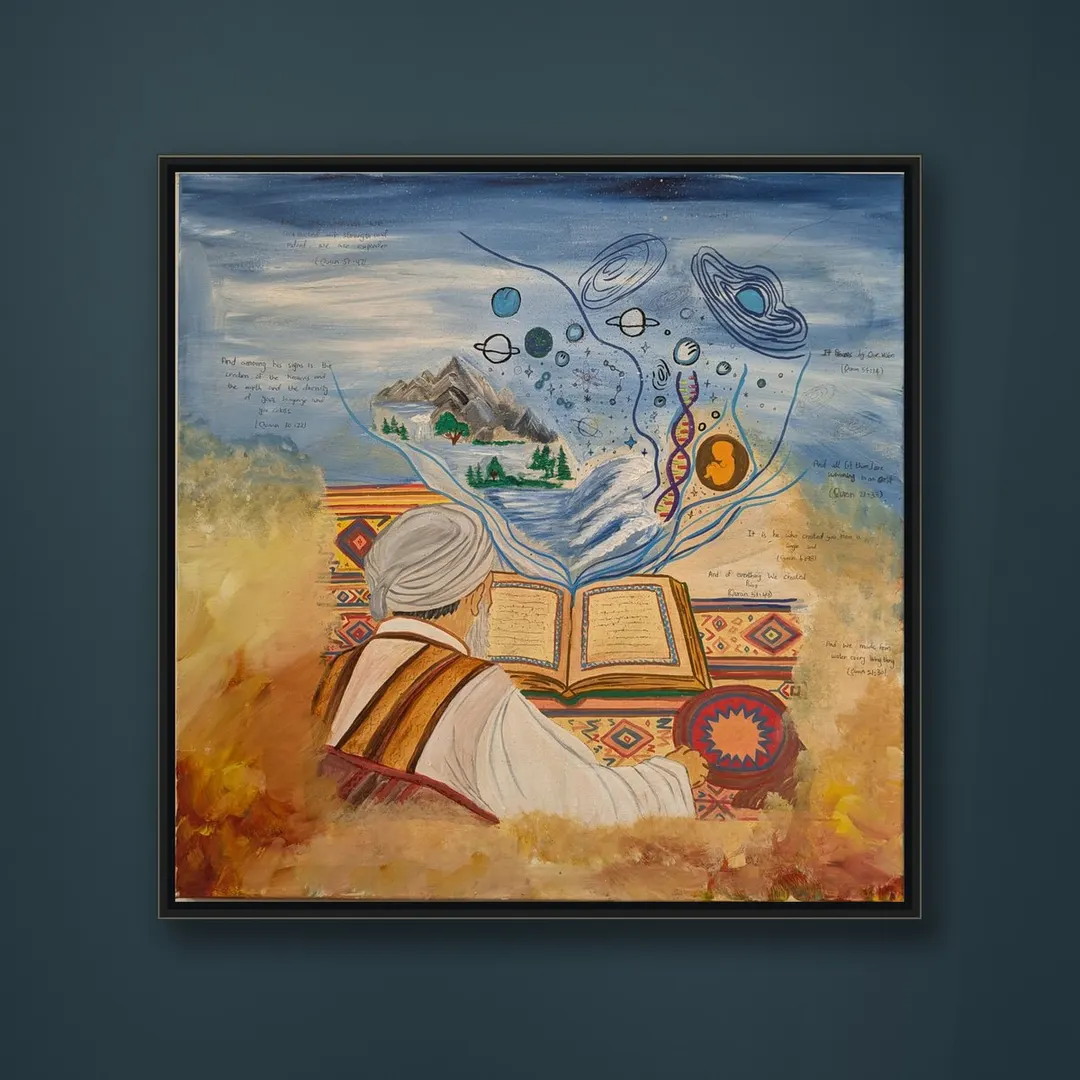
Ayat (Signs in the Universe) by Hafsa Imran in a dark frame on a deep teal wall
Ayat, hand-painted by Hafsa Imran. The frame and wall are a digital presentation of the photograph.

Ask about the work

Interested in Ayat?

Collectors, curators, writers and anyone the painting has stayed with can message the studio directly. Hafsa reads every message.

Share the work

Ayat, ready for every screen

Share it with credit to Hafsa Imran and a link to this page. For print, publication or any commercial use, please message the studio first.

  • Ayat (Signs in the Universe) by Hafsa Imran in a dark frame on a deep teal wall

    Portrait

    Instagram post or story · 1080×1350

    Download
  • Ayat (Signs in the Universe) by Hafsa Imran in a dark frame on a deep teal wall, square format

    Square

    Facebook, WhatsApp status · 1200×1200

    Download
  • Ayat (Signs in the Universe) by Hafsa Imran, framed, on a wide deep teal wall

    Wide

    LinkedIn, X, a website banner · 1920×1080

    Download
  • Ayat (Signs in the Universe), a painting by Hafsa Imran, high-resolution photograph of the original

    High resolution

    Press and print · 3000×3002

    Download
Ask about this painting

We use cookies to understand how you use our website and to improve your experience. Your data helps us serve you better. Learn more